
Sandpiper Species Stock Video Footage
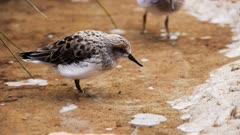
The sandpipers exhibit considerable range in size and appearance, the wide range of body forms reflecting a wide range of ecological niches. Sandpipers range in size from the least sandpiper, at as little as 18 grams (0.040 pounds) and 11 cm (4.3 in) in length, to the Far Eastern curlew, at up to 66 cm (26 in) in length, and the Eurasian curlew, at up to 1.3 kg (2.9 lb). Within species there is considerable variation in patterns of sexual dimorphism. Males are larger than females in ruffs and several sandpipers, but are smaller than females in the knots, curlews, phalaropes and godwits. The sexes are similarly sized in the snipes, woodcock and tringine sandpipers. Compared to the other large family of wading birds, the plovers (Charadriidae) they tend to have smaller eye, more slender heads, and longer thinner bills. Some are quite long-legged, and most species have three forward pointing toes with a smaller hind toe (the exception is the sanderling, which lacks a hind toe). Sandpipers are more geared towards tactile foraging methods than the plovers, which favour more visual foraging methods, and this is reflected in the high density of tactile receptors in the tips of their bills. These receptors are housed in a slight horny swelling at the tip of the bill (except for the surfbird and the two turnstones). Bill shape is highly variable within the family, reflecting differences in feeding ecology. Bill length relative to head length varies ... Learn more about Sandpiper
View all family groups for: Marine Bird
Sandpiper Species Videos
| Common Name | Scientific Name | Conservation Status |
|---|---|---|
| American Woodcock(3 videos) | Scolopax minor | Least concern |
| Australian Painted Snipe(4 videos) | Rostratula australis | Endangered |
| Baird's Sandpiper(9 videos) | Calidris bairdii | — |
| Banded Lapwing(4 videos) | Vanellus tricolor | Least concern |
| Bar-tailed Godwit(107 videos) | Limosa lapponica | Near threatened |
| Black-fronted Dotterel(19 videos) | Elseyornis melanops | Least concern |